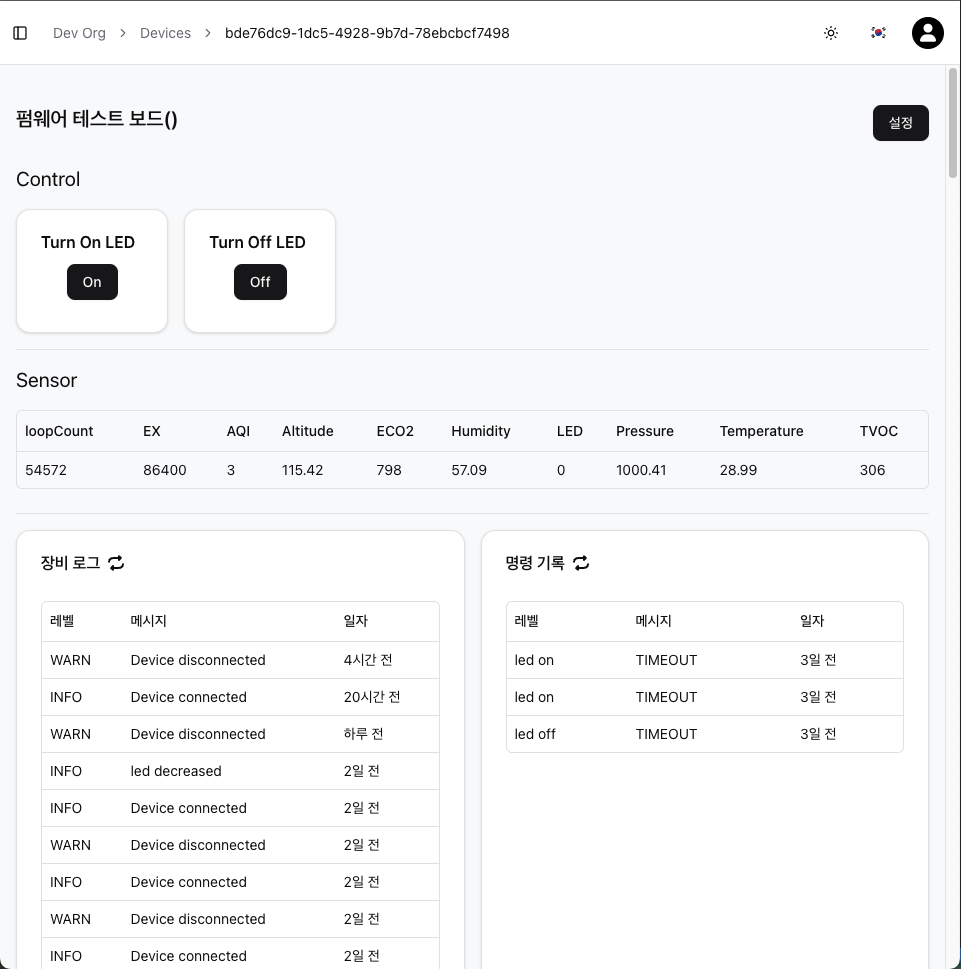
Device
A digital twin layer that abstracts and manages a standalone IoT device with a specific purpose on the Alpaconnect service. It acts as a logical link between the actual IoT device and the cloud service. For a device to function, a data connection through the APC Link layer must be established.
A device performs three main actions:
1. Periodic Transmission of Sensor Data
The device collects data from connected sensors and transmits it to the cloud server at set intervals.
Example: The sensor collects real-time data such as temperature, humidity, and CO2 concentration, sends it to the APC Link via MQTT protocol, and this data is then sent to the cloud server and displayed on the dashboard. This allows users to monitor environmental conditions in real time from remote locations.
2. Event Detection and Transmission
The actual device detects situations where certain conditions or thresholds are exceeded and immediately reports them to the server as events.
Example: If a temperature sensor exceeds a set threshold (e.g., 30°C), the device generates a “temperature warning” event and sends it to the server. Changes in device connection status (connected/disconnected), sensor malfunctions, or low battery are also detected and sent as events. These events are logged in the system and can be used to send notifications to users as needed.
3. Receiving and Processing Action Commands
The device receives control commands sent from the server and controls the physical device accordingly.
Example: If a user sends a “turn on the fan” command via the dashboard control interface, the command is converted to an MQTT message by the cloud server, sent to the actual IoT device via the APC Link, and the device then physically operates the relay to power the fan. The result of the command execution is reported back to the server and recorded in the command log.
All functions and behaviors of a device are defined in a template called a Model. Each device must be implemented based on a single Model, which determines what sensor data the device collects, what events it detects, and what actions it can perform. A single Model can be shared by multiple devices, providing an efficient structure for managing many devices of the same type.
Through the dashboard, users can monitor the current sensor values of each device in real time, check device logs to track important events such as connection status, and review action command history and results. This comprehensive interface enables remote monitoring and control of the physical IoT device.